Night Shift on Three Wheels: The Becak Drivers Keeping Semarang's Soul Alive After Dark
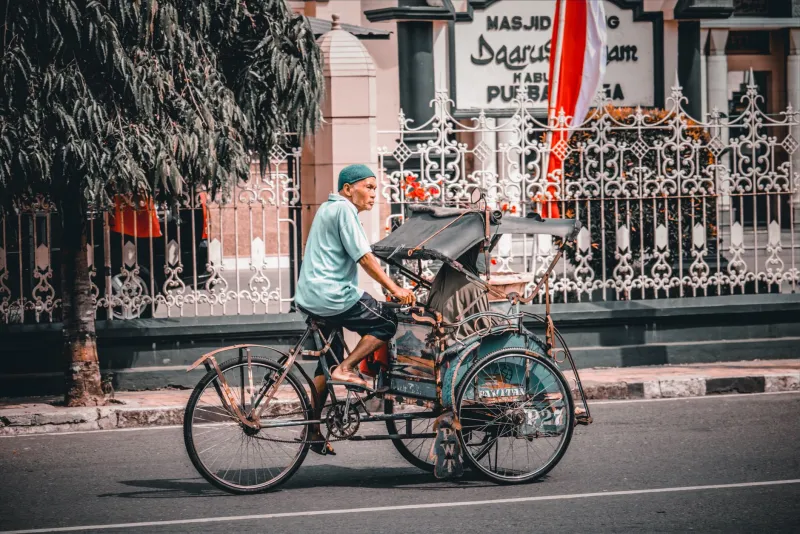
It's just past midnight on Jalan Pemuda, and most of Semarang is already asleep. The street vendors have packed up their carts, the last of the karaoke bars are winding down, and the only sound cutting through the humidity is the slow, rhythmic creak of a bicycle chain. That's Pak Warno, 58 years old, third-generation becak driver, settling into his evening pace.
"The night is mine," he says without a hint of drama, adjusting the worn cushion on his seat. "In the daytime, everyone is rushing. At night, people actually want to talk."
The becak — a three-wheeled pedicab where the driver pedals from behind a covered passenger seat — has been part of Indonesian street life for over a century. In Semarang, these vehicles were once as common as taxis are in New York City. Today, they're something closer to a living relic, still moving through the city's veins but increasingly invisible to a generation raised on Gojek and Grab.
A Profession Written in Calluses
Pak Warno learned to drive a becak from his father, who learned from his. He never really considered doing anything else, though he'll admit that wasn't always a choice freely made. "School cost money we didn't have," he says matter-of-factly. "The becak was already there. It fed us."
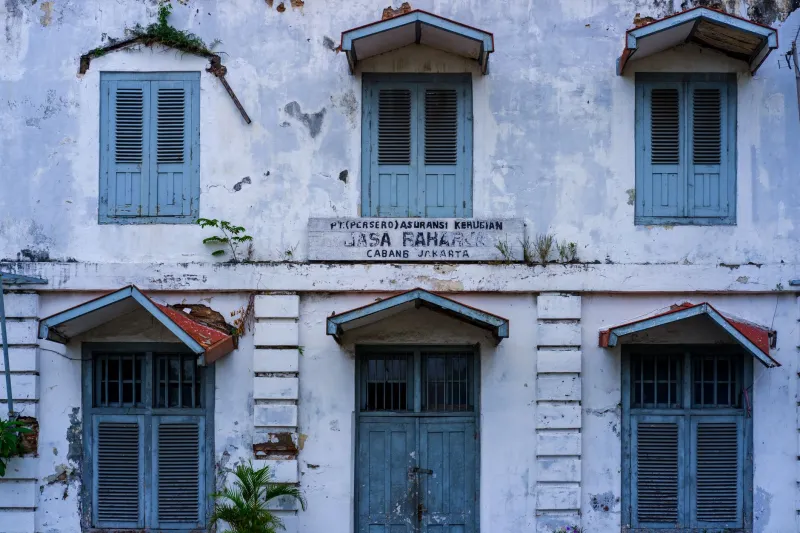
He operates out of the Kota Lama district — Semarang's Dutch colonial old town — which, conveniently for him, has become a modest tourist draw in recent years. The cobblestone lanes and faded 18th-century facades make for an atmospheric backdrop, and the occasional traveler who wanders through looking for something more textured than a Grab ride sometimes ends up in his passenger seat.
But those moments are rare enough that Pak Warno can't count on them. His average nightly haul — pedaling from roughly 9 p.m. to 4 a.m. — brings in somewhere between 50,000 and 80,000 Indonesian rupiah. That's roughly three to five U.S. dollars for seven hours of physical labor in tropical heat.
He's not complaining. Or rather, he's complaining, but with the philosophical acceptance of someone who's been doing this long enough to know that things were once worse and might get worse again.
The App Problem, Explained by the People It Displaced
Ask any becak driver in Semarang about ride-sharing apps and you'll get the same complicated shrug. They know Gojek changed everything. They're not entirely bitter about it.
"Gojek is fast. It's cheap. I understand why people use it," says Mas Eko, 44, who parks his becak near the old Tawang train station most nights. "But a motorcycle can't carry your grandmother's furniture. A motorcycle driver won't wait two hours while you visit a sick relative in the hospital."
He's pointing to something real. The becak's staying power isn't speed — it never was. It's capacity, patience, and a kind of unhurried intimacy that the gig economy hasn't figured out how to monetize. Mas Eko regularly serves elderly residents who don't own smartphones, market vendors who need to transport bulk goods through narrow alleys, and the occasional drunk office worker who just needs to get home slowly enough to sober up a little.
Some drivers have tried to adapt more directly. A few younger becak operators in the city have started listing their services on WhatsApp community groups, effectively building their own micro-networks of regular customers. It's not exactly disrupting the disruption, but it's something.
Friendships Forged at 2 A.M.
If there's a hidden reward in this work, it lives in the conversations. Becak drivers hear things. They're trusted in the way that bartenders and cab drivers are trusted — present but somehow neutral, moving through the city without quite belonging to any one part of it.
Pak Warno tells the story of a young woman he picked up outside a hospital about two years ago. She'd just received difficult news about her mother. She didn't say where she wanted to go. She just sat in the passenger seat and cried for a while, and he pedaled slowly around the same few blocks until she was ready to go home. He didn't charge her.
"She brings me food sometimes now," he says. "Nasi bungkus. She remembers."
Mas Eko has a standing arrangement with a night security guard at a nearby hotel — they share cigarettes and gossip during the slow hours between 2 and 4 a.m., when even Semarang's most determined insomniacs have given up and gone to bed. "We've never met in the daytime," Eko says. "I don't even know his last name. But I know everything about his family."
These are the connections that don't show up in any economic analysis of the informal labor sector. They're also the ones that make the work survivable.
What Gets Lost When the Last Becak Stops
Urban planners and tourism officials in Semarang have occasionally floated the idea of formalizing becak routes — essentially turning them into a heritage attraction, the way some cities have done with horse-drawn carriages. The drivers themselves are lukewarm on the idea. Being turned into a photo opportunity feels like a different kind of erasure.
"I'm not a museum exhibit," Pak Warno says, though without much edge. "I'm just a man who works."
That tension — between preservation and dignity, between nostalgia and livelihood — sits at the heart of what's happening to Semarang's becak culture. The city is modernizing fast, and that's mostly a good thing. But modernization has a habit of flattening out the texture of daily life, and it's worth asking what disappears when the last becak driver finally decides the math no longer adds up.
For now, though, the math still adds up. Barely. And so Pak Warno keeps pedaling, long after the city has gone quiet, threading his three-wheeled vehicle through streets that have seen empires rise and fall and are still, somehow, standing.
Around 3 a.m., he picks up a passenger — a middle-aged man heading home from a late shift at a printing factory. They don't talk much. The man falls half-asleep in the passenger seat. Pak Warno pedals steadily, reading the streets by memory and muscle.
Some things, it turns out, don't need an app. They just need someone willing to show up in the dark and do the work.