Ghosts in the Water: Semarang's Harbor Is Giving Up Secrets That Rewrote the History Books
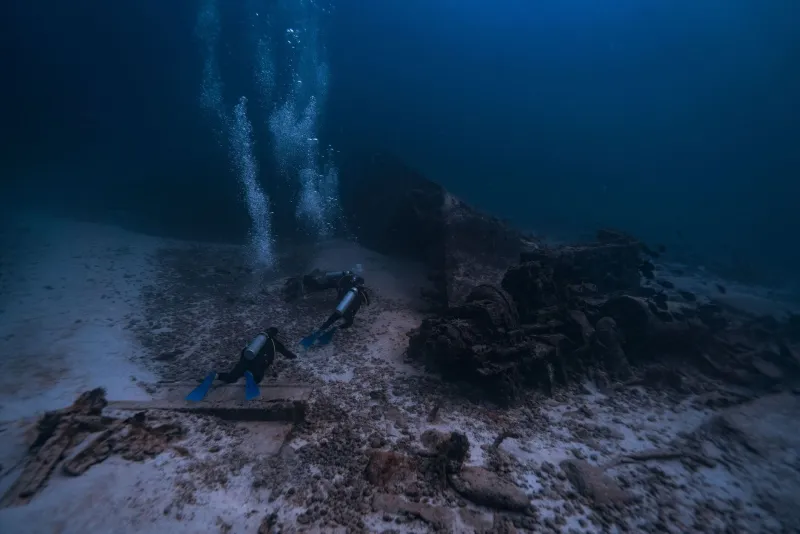
There's a moment, divers say, when you drop below the surface of Semarang's harbor and the noise of the city just disappears. The traffic, the street food vendors, the hum of one of Indonesia's busiest port cities — all of it gone. What's left is murk, pressure, and the occasional shape of something that has no business being on the seafloor.
That shape might be a cannon. It might be the ribbed skeleton of a trading vessel that sank three centuries ago. Or it might be something nobody has a name for yet.
Semarang has always been a port city. But what's emerging from its waters right now is more than just old cargo. It's a counter-narrative — one that local historians and amateur divers are piecing together piece by piece, dive by dive, in direct contrast to the version of history that Dutch colonial administrators wrote and the world largely accepted.
A Harbor That Never Stopped Talking
Semarang sits on the northern coast of Java, and its harbor has been a commercial hub for well over four hundred years. Long before the Dutch East India Company — the VOC — showed up and started treating the entire Indonesian archipelago like a corporate asset, this stretch of coastline was already thick with trade. Chinese merchants, Javanese sailors, Arab spice traders — they all passed through here, and they all left something behind.
The problem, historically, is that the version of events that survived was largely the one Europeans wrote down. Colonial records documented what the Dutch built, what they exported, what they taxed. The deeper, messier, more complicated story of who was actually doing the trading, the navigating, and the cultural exchange? That part got buried. Sometimes literally.
When you factor in that Semarang's coastline has shifted significantly over the centuries due to land subsidence and sedimentation — a phenomenon that continues to affect the city today — you start to understand why so much of that buried history ended up underwater.
What the Divers Are Finding
Over the past decade or so, a loose coalition of local diving enthusiasts, university researchers from institutions like Universitas Diponegoro, and independent maritime archaeologists have been systematically exploring the harbor's shallower zones. The finds have ranged from the mundane to the genuinely startling.
Ceramic fragments bearing Chinese dynasty markings predate Dutch colonization by centuries, suggesting trade networks that ran directly from Java to Chinese ports without any European middlemen. Anchors and hull remnants from vessels that don't match any Dutch shipbuilding style have raised questions about whose ships were actually dominating these waters before the VOC arrived. And in some cases, the positioning of wreck sites has helped researchers map out trade routes that simply don't appear in any official colonial record.
"The sea doesn't lie the way documents can," one local historian involved in the research told us. "When you find a Chinese porcelain jar sitting next to Javanese pottery in twelve feet of water, that's a conversation that happened. You can't revise it."
For context, think of it like discovering that a major American port city had a thriving pre-colonial trade economy that was systematically erased from the official record — and then finding the receipts at the bottom of the harbor. That's roughly the scale of what's happening here.
Reclaiming the Narrative
What makes this story particularly compelling for anyone paying attention to global conversations about history and who gets to tell it, is how deliberately local this effort is. This isn't primarily a foreign-funded excavation with international teams flying in to do the work and fly home with the credit. The people doing the diving, the cataloguing, the arguing over what a particular artifact means — they're mostly from Semarang.
That matters. Indonesia spent roughly three and a half centuries under Dutch colonial rule, and the psychological and cultural weight of that history is still being sorted out. When local researchers are the ones pulling pre-colonial trade goods from their own harbor and saying, "look, we were already connected to the world long before anyone colonized us," that's not just an archaeological finding. It's a reclamation.
Several of the recovered artifacts have made their way into Semarang's local museums, where they're displayed with context that deliberately pushes back against the colonial framing that still dominates many history textbooks used in Indonesian schools. Educators in the city have started incorporating harbor archaeology into school programs, bringing students to the waterfront and asking them to think about whose stories are told and whose get dropped into the deep.
The Challenges Nobody Talks About
It would be easy to frame all of this as a triumphant story of discovery, but the reality is messier. Semarang's harbor is an active, working port. Visibility underwater is often terrible. Pollution is a serious issue. And the legal framework for maritime archaeology in Indonesia, while improving, is still catching up to the volume of sites that need protection.
There's also the uncomfortable truth that not all underwater finds stay in museums. The black market for Southeast Asian maritime artifacts is real, and not every diver who goes down into those waters is going down with research in mind. Several significant pieces have reportedly disappeared before they could be properly documented, lost to private collectors who will never let them be studied.
Preservation funding is chronically tight. International attention, when it comes, tends to be sporadic. And the harbor itself continues to change — Semarang's land subsidence problem means that some sites are shifting and degrading faster than they can be documented.
Why This Should Matter to You
If you're reading this from the United States, you might be wondering what any of this has to do with you. Fair question. Here's one answer: the conversation happening at the bottom of Semarang's harbor is the same conversation happening everywhere people are re-examining whose version of history became the official one.
The tools are different — in this case, they're dive masks and waterproof cameras instead of archive boxes — but the questions are identical. What do we lose when only one side of a story gets written down? What do we find when we go looking for the version that got buried?
Semarang's harbor has been sitting on those answers for centuries. The city is finally starting to listen.
If you ever make it out here — and honestly, you should — you can catch some of the recovered artifacts at the Semarang City Museum in the Old Town district. The harbor itself is visible from the waterfront near the old Dutch fortifications, where the water looks deceptively still and ordinary.
It's anything but.