Trash Into Treasure: Meet the Semarang Activists Turning the City's Plastic Problem Into a Creative Revolution
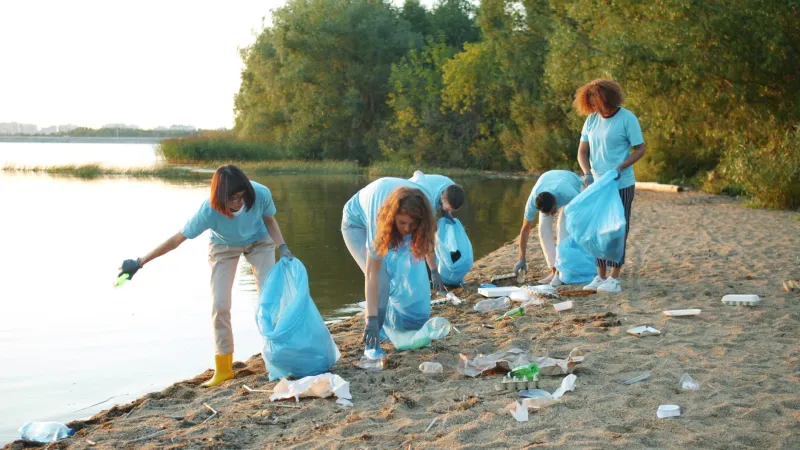
On a Saturday morning along the banks of the Banjir Kanal Barat, a drainage canal that cuts through western Semarang, a group of about thirty people is doing something that looks, at first glance, like the world's least glamorous treasure hunt. They're wading through knee-deep water in rubber boots, pulling plastic bottles, foam containers, and tangled packaging out of the murk with long-handled nets and bare hands.
By the afternoon, what they've collected will be sorted, cleaned, and trucked to a workshop on the edge of the city. By next month, some of it will be a chair. Some of it will be earrings. Some of it will be a wall panel in a café that a young designer is opening near the university district.
This is Semarang's plastic war, and it is being fought with creativity as much as conviction.
A Problem That's Hard to Ignore
Indonesia is one of the world's largest contributors to ocean plastic pollution — a fact that makes headlines internationally but often lands differently when you're standing next to a clogged waterway in a residential neighborhood. Semarang's canal system, built partly during the Dutch colonial era to manage flooding, has become an inadvertent collection point for the city's waste. When the rains come hard, plastic that's accumulated along streets and in drainage ditches flushes into the canals and eventually toward the Java Sea.
For residents who've lived near these waterways for generations, the degradation has been gradual enough to become almost invisible — the slow normalization of a landscape that shouldn't look this way. It took outsiders, in some cases, to start naming what locals had learned to unsee.
"My grandmother used to fish in this canal," says Dewi, 31, who co-founded a community cleanup collective after returning to Semarang from a stint working in Surabaya. "When I came back and really looked at it, I couldn't believe we'd all just accepted it."
The Workshop at the End of the Canal
Dewi's collective isn't just running cleanup days. The real innovation is what happens after the plastic comes out of the water. In partnership with a small design studio, the group has developed processes for sorting, shredding, and heat-pressing recovered plastic into raw material sheets that can be cut and shaped into products.
The results are genuinely striking. Flecked with the random color distribution of mixed plastics — blue bottle caps, yellow food containers, clear packaging — the finished material has an aesthetic that's somewhere between terrazzo and abstract painting. It doesn't look like trash. It looks like something you'd see in a design shop in Brooklyn or Silver Lake.
That visual appeal is intentional and strategic. "If we just told people this is recycled plastic, some people care and most people don't," says Andi, the designer who developed the material process. "But if people see something beautiful and then find out where it came from, that's a different conversation."
The collective has sold pieces to hotels, restaurants, and individual buyers. Revenue flows back into funding cleanup operations and paying the community members — many of them from low-income neighborhoods along the canals — who do the collection work.
Fashion Forward, From the Waterway
Not all the plastic ends up as furniture. A separate enterprise, run by a pair of sisters in their late twenties, is working in a smaller scale and a faster medium: accessories. Rings, pendants, and hair clips made from reclaimed plastic have found an audience among Semarang's younger consumers and, increasingly, buyers reached through Instagram and marketplace apps.
The sisters — Rini and Sari — are careful about what they claim and what they don't. "We're not going to save the ocean by making earrings," Rini says, laughing. "But we can show people that this material has value. Once you see value in it, you stop throwing it away so easily."
Their pieces have been featured in a regional fashion showcase and caught the attention of a sustainable accessories buyer based in Bali who works with international retailers. Negotiations, they say, are ongoing.
The Limits of Grassroots
For all the genuine energy in this movement, the people driving it are clear-eyed about what community organizing alone cannot fix. The plastic flowing into Semarang's canals is a systemic problem — inadequate waste collection infrastructure, limited municipal recycling capacity, and consumer packaging norms that generate enormous volumes of single-use plastic daily.
Activists here are vocal about the need for policy change alongside community action. They want extended producer responsibility laws that hold manufacturers accountable for packaging waste. They want the city to invest in waste collection in neighborhoods that currently have no reliable service. They want what they're doing in workshops and on canal banks to be understood as a stopgap, not a substitute for structural solutions.
"We can clean the canal every weekend for the rest of our lives," Dewi says. "And we'll keep doing it. But the real win is when we don't have to anymore."
A City Learning to See Itself Differently
What's most interesting about Semarang's plastic movement, from the outside, is the way it's reshaping how residents relate to the city's physical landscape. Waterways that were background noise — ignored, avoided, taken for granted — are becoming sites of community identity and civic pride.
School groups visit the workshop. Local journalists have started covering cleanups as genuine news rather than feel-good filler. A few city council members have shown up to wade in the canal alongside volunteers, whether out of genuine conviction or political calculation — probably some of both.
The canal isn't clean yet. Not even close. But it's becoming a place where people gather, argue, create, and imagine a version of the city that's worth fighting for. In Semarang, that's not nothing. That might actually be everything.