Speak Now or Forever Hold Your Peace: The Race to Save Semarang's Vanishing Tongues
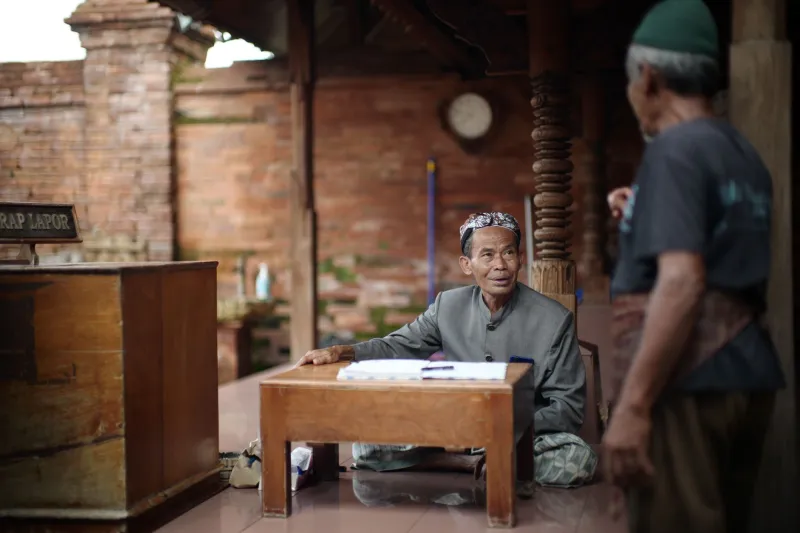
Sri Wahyuni is 74 years old, and she talks like nobody else in her neighborhood. Not because she's loud or particularly opinionated — though she is both — but because the Javanese she speaks is a flavor of the language that most people under forty have never heard and couldn't parse if they tried. It's thick with honorifics, salted with older loan words from Dutch and Hokkien Chinese, and shaped by a coastal cadence that marks her as someone who grew up in Semarang's harbor district before the port swallowed most of what made it human.
"My grandchildren understand me," she says, stirring a glass of sweet tea. "But they can't answer back. Not the way I speak."
That gap — between understanding and speaking, between receiving a language and carrying it forward — is exactly what worries the small but increasingly urgent community of linguistic preservationists working across Semarang today.
A City of Many Mouths
Most Americans think of Indonesia as a country where people speak Indonesian. And technically, that's true — Bahasa Indonesia is the national language, the one taught in schools, broadcast on television, and used in government offices. But Indonesia is also home to somewhere between 700 and 800 distinct regional languages, depending on how you count, and Semarang sits at a particularly rich crossroads of them.
The city's history as a trading port means it absorbed waves of Javanese speakers from different inland regions, Hokkien-speaking Chinese merchants who arrived centuries ago and never entirely left, Madurese laborers, Arabic-descended Peranakan communities, and the layered Dutch colonial presence that lasted over three centuries. Each of those groups left linguistic fingerprints on the city's speech — particular words, intonations, code-switching habits that locals still use without necessarily knowing where they came from.
But those fingerprints are fading. Fast.
"Indonesian is easier," says Dimas Prasetyo, a 26-year-old linguistics graduate student at Diponegoro University who has been documenting Semarang's speech communities for the past two years. "English is useful. Javanese — especially the older, more formal registers — feels like a lot of work for something your boss doesn't need you to know."
He's not wrong, and he's not judging. He grew up speaking a simplified version of Javanese at home and is only now, through his research, learning the deeper grammatical structures his grandparents used fluently.
The App That Started an Argument
Last year, a small tech startup based in Semarang launched a mobile app called Basa Kita — roughly translatable as "Our Language" — designed to teach conversational Javanese to beginners, with a specific focus on Semarang's coastal dialect. It used gamified lessons, audio recordings from elderly native speakers, and a community forum where learners could practice.
The response was immediate and, somewhat unexpectedly, contentious.
Purists in the Javanese cultural community argued that the app oversimplified the language's complex honorific system, which has distinct registers for speaking to elders, peers, and social inferiors. Younger users complained that the honorific complexity was exactly the problem — that it encoded a class hierarchy they didn't want to perpetuate. Meanwhile, the Hokkien-speaking community pointed out, not unkindly, that the app ignored them entirely.
"Language isn't just vocabulary," says Rina Susanti, one of the app's co-founders, who seems genuinely energized rather than discouraged by the pushback. "It's politics. It's memory. You touch it and everyone has feelings."
The controversy ended up being the best marketing the app ever got. Downloads tripled after a local news segment covered the debate, and Basa Kita now has over 40,000 registered users across Central Java.
What Gets Lost in Translation
Dimas takes me to a community cultural center in Kampung Melayu, one of Semarang's older mixed-heritage neighborhoods, where a weekly language circle meets on Thursday evenings. The group is maybe fifteen people — a few retirees, a couple of young teachers, a woman who runs a batik workshop, and two college students who found out about the gathering through Instagram.
The format is loose. Someone reads a poem in an older Javanese register. Someone else attempts a translation into modern Indonesian. The group discusses what got lost in the move between versions.
Tonight's poem is about a fishing boat returning to harbor at dusk. In the original, there's a word — nggremet — that describes the specific quality of light on water when clouds are starting to build but rain hasn't arrived yet. There's no clean Indonesian equivalent. The college students pull out their phones and spend five minutes trying to find an approximation. They can't.
"That's the thing," says Pak Harto, a retired schoolteacher who has been attending since the group started three years ago. "When the word disappears, the thing it was pointing at becomes harder to see. You don't just lose language. You lose a way of paying attention."
Gen Z Shows Up (Sort Of)
The generational picture is more complicated than a simple story of young people abandoning tradition. Some of the most passionate language activists in Semarang are in their early twenties, motivated partly by a broader Gen Z interest in cultural identity and partly by the very real sense that something irreplaceable is slipping away.
Farida, 22, runs a TikTok account with nearly 80,000 followers where she posts short videos teaching Semarang-specific slang, old Javanese proverbs, and the occasional Hokkien phrase still used in the city's Chinese-Indonesian community. Her approach is deliberately irreverent — she'll explain an ancient honorific while eating mie ayam and making faces at the camera.
"People tell me I'm not being serious enough," she says. "But serious didn't work. Serious is why everyone stopped learning."
Her comment metrics suggest she's onto something. The videos where she connects old language to current life — showing how a centuries-old Javanese phrase maps onto a modern situation, or tracing how a Hokkien word ended up in everyday Semarang slang — consistently outperform the straightforward lesson-style content.
The Urgency Underneath
Linguists estimate that a language dies somewhere in the world roughly every two weeks. Indonesia, with its extraordinary linguistic diversity, is one of the countries most acutely affected by this trend. Semarang is not facing extinction-level loss — Javanese is spoken by tens of millions of people and isn't disappearing anytime soon. But the specific dialects, registers, and minority language pockets that make Semarang's speech distinct from Yogyakarta or Solo or Surabaya? Those are genuinely endangered.
What the activists, the app builders, the TikTok educators, and the Thursday night poetry circle share is a conviction that the loss of linguistic specificity is a loss of something harder to name — a sense of place, a mode of belonging, a way a city has of knowing itself.
Sri Wahyuni, back in her kitchen, doesn't use any of that theoretical language. She just says she wants her grandchildren to be able to argue with her properly someday.
"Right now they just nod," she says, laughing. "Nodding is not a conversation."
She's right about that. And somewhere in the gap between nodding and actually talking back, a city's whole way of speaking to itself is either going to survive or quietly disappear.