Stars Over Smokestack City: Meet the Rooftop Astronomers Refusing to Let Semarang's Sky Go Dark
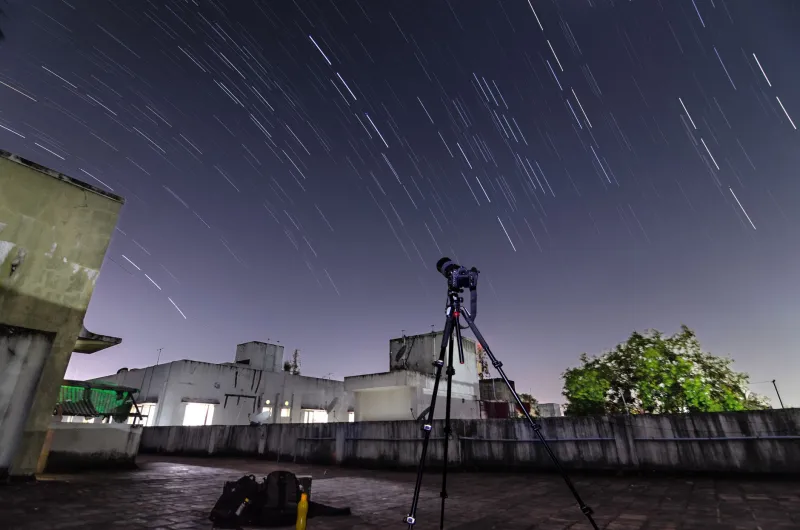
On the roof of a six-story apartment building in Semarang's Tembalang district, Agus Wibowo is doing something that looks, from a distance, like he's arguing with the sky. He's crouched behind a mid-range refractor telescope, adjusting the eyepiece with the focused irritation of someone who knows exactly what they're looking for and is deeply annoyed at everything blocking their view.
What's blocking his view tonight: a low bank of humid haze rolling in off the Java Sea, the amber glow of approximately 1.7 million people's worth of streetlights, the floodlit silhouette of a container ship terminal, and a faint chemical shimmer that he attributes, with practiced resignation, to the industrial corridor south of the city.
"Saturn is up there," he says, not moving from the eyepiece. "I can find it. I just have to want it badly enough."
He finds it. Of course he finds it.
A Hobby That Shouldn't Work Here
Semarang is not, on paper, a great place to be an amateur astronomer. It sits at roughly 7 degrees south latitude, which gives it decent access to southern sky objects, but it's also a dense, humid, industrially active port city with light pollution levels that make serious deep-sky observation a genuine exercise in stubbornness. The kind of dark skies that American stargazers drive hours into the Nevada desert to find simply don't exist within city limits.
And yet, Semarang has developed one of the most active amateur astronomy communities in Central Java — possibly in all of Indonesia outside Jakarta. The Komunitas Langit Semarang (Semarang Sky Community) has over 300 registered members, runs monthly public observation nights, maintains a group chat that never sleeps, and has somehow convinced three different building owners to let them set up semi-permanent telescope stations on rooftops across the city.
How did a hobby that depends on darkness flourish in a city that generates so much light?
"Exactly because of the difficulty," says Rini Hartati, a 31-year-old high school science teacher who co-founded the community six years ago with a borrowed telescope and a WhatsApp group of seven people. "If the sky were easy here, maybe we'd take it for granted. Because it's hard, we pay attention."
The Gear, the Grit, and the Workarounds
Visiting a Komunitas Langit observation night is a masterclass in creative problem-solving. Members show up with equipment that ranges from a kid's department-store refractor duct-taped to a camera tripod to a serious 10-inch Dobsonian reflector that takes two people to carry up a flight of stairs. There's no gatekeeping about gear. The community's unofficial motto, according to Agus, is roughly: "Any telescope beats no telescope."
The workarounds they've developed for urban stargazing are genuinely clever. Members share real-time light pollution maps of the city, flagging nights when industrial activity is lower and the air is relatively clear. They've catalogued which rooftops face which directions and which objects are best observed from each location — the harbor-facing roof is good for planets near the horizon in certain seasons; the university-district building has a cleaner southern view for Centaurus and Crux.
For deep-sky objects that the city glow simply swamps, members pool money for occasional overnight trips to the highlands south of Semarang, where the air clears and the Milky Way becomes visible in a way that makes first-timers go quiet.
"The first time someone sees the galactic core for real," Rini says, "they cry. I don't mean metaphorically. I mean actual tears. Every time."
The Fight They Didn't Expect to Be In
About two years ago, the community stumbled into something bigger than stargazing. A proposed expansion of a commercial lighting installation near one of their primary observation rooftops — a massive LED advertising array on a nearby shopping complex — threatened to effectively blind their best urban site.
Agus wrote a letter to the city planning office. He expected nothing. He got a meeting.
"We went in talking about astronomy," he says. "We came out talking about sleep disorders, wildlife disruption, energy waste, human health. Light pollution is not a niche problem. We just happened to be the people who noticed it first because we were looking up."
The shopping complex's lighting array was ultimately approved, but at reduced intensity and with directional shielding that the community negotiated for. It was a partial win — the kind that feels like a loss until you realize what the alternative was.
The experience radicalized several members into broader environmental advocacy. The community now formally collaborates with a local environmental NGO and has submitted public comments on three subsequent development projects with significant lighting components.
Not bad for a group that started as a WhatsApp chat about Saturn.
Why Now? Why Here?
Several members offer theories about why this community exploded in the last five or six years specifically. The pandemic gets mentioned — lockdowns pushed people onto rooftops and balconies, and looking up was one of the few available forms of escape. Social media helped: stunning astrophotography shared in Indonesian astronomy groups inspired people who'd never considered the hobby to try it.
But there's something else, something harder to quantify, that comes up in almost every conversation. Semarang is a city in rapid transformation — new infrastructure, accelerating development, the constant churn of a port economy. For many residents, especially younger ones, there's a low-grade anxiety about what the city is becoming and what it's leaving behind.
Looking at the Andromeda galaxy, which sits 2.5 million light-years away and is visible as a faint smudge through a modest telescope, has a way of recalibrating that anxiety.
"When I look at something that old," says Dian, a 24-year-old graphic designer who joined the community last year, "whatever stressed me out that week becomes very small. Not unimportant. Just small. There's a difference."
The Rooftop as Community Space
What's striking about a Komunitas Langit observation night isn't just the astronomy. It's the atmosphere. People bring snacks. Someone always brings a thermos of coffee. The conversation migrates freely between eyepiece technique, local politics, family gossip, and the genuinely mind-bending scale of the observable universe.
Kids show up with parents who wanted to share something they love. Couples come on dates. A retired civil engineer named Pak Slamet comes every month and mostly just sits in a folding chair, occasionally looking through someone else's telescope when invited, content to be near people who care about something strange and beautiful.
"I don't understand all the technical parts," he admits cheerfully. "But I like the feeling. Everyone here is looking at the same thing and feeling very small together. That is a nice thing to share."
Agus, still at the eyepiece, finally steps back and waves someone over to look at Saturn. The rings are tilted at a particularly favorable angle this season, and even through the city glow, through the haze and the light pollution and the industrial shimmer, they're unmistakable.
The person who steps up — a teenager who came with her older sister and has been hanging back all evening — looks through the eyepiece and goes completely still.
For about thirty seconds, nobody says anything.
Then she steps back, looks at Agus, and says: "That's real?"
"That's real," he confirms.
She goes back to the eyepiece. The city hums below them, indifferent and luminous. The rings of Saturn hold their shape across 800 million miles of space, patient as anything.