She Runs This Block: The Single Mothers Quietly Building Semarang's Shadow Economy
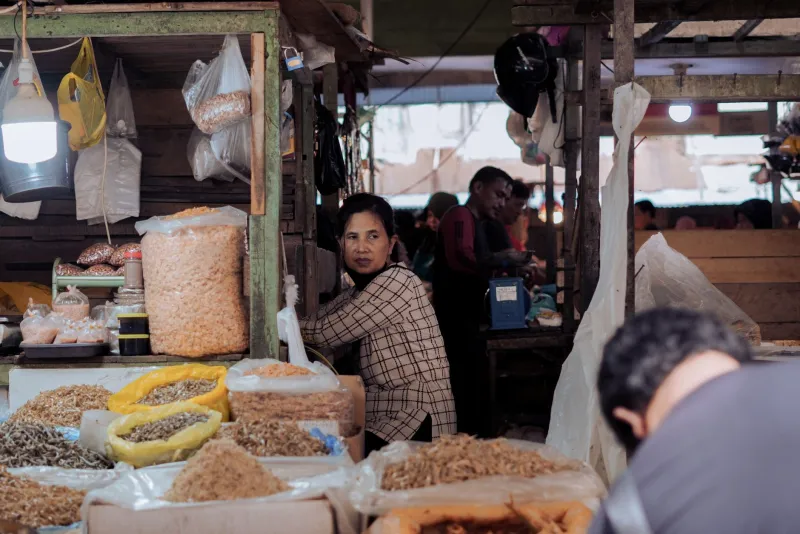
Ibu Parti wakes up at 3:30 in the morning. Not because an alarm tells her to — she stopped needing alarms years ago — but because the day has its own logic and the logic starts early. By 4 a.m. she's at the wet market in Karangayu, moving through the stalls with the efficiency of someone who has been doing this for fifteen years and knows exactly which vendor will give her the freshest tempeh and which one is trying to move inventory that's been sitting since yesterday. By 6 a.m. she's back at her stall, which occupies a strip of sidewalk outside a housing complex in West Semarang, and the first customers are already waiting.
Ibu Parti is 48 years old. She has been widowed since she was 33. She has put two children through school on the income from this stall and is currently helping a third save money to attend vocational college. She runs a small informal lending circle that serves eleven other women in her neighborhood. She has never had a business loan, a formal business license, or, until recently, a bank account.
"The bank didn't seem like it was for people like me," she says, not bitterly — just factually, the way you'd note the weather.
The Invisible Infrastructure
Semarang's formal economy gets most of the attention: the port, the industrial estates, the growing tech sector, the commercial real estate that keeps rising along the main boulevards. But underneath all of that — threaded through the kampungs, the side streets, the covered walkways of residential neighborhoods — runs a parallel economy that doesn't appear in official statistics and doesn't get written up in business journals.
It is, to a remarkable degree, run by women like Ibu Parti.
Widowed and single mothers occupy a peculiar position in Indonesian society. Tradition places enormous weight on the male breadwinner model, and women who find themselves heading households alone — through death, divorce, or abandonment — often do so without social safety nets, formal credit access, or the professional networks that might ease their path. What they frequently have instead is necessity, resourcefulness, and each other.
The informal economic networks that have grown out of that combination are more sophisticated than they might appear from the outside.
Arisan and Beyond
Most Americans have no direct equivalent for arisan, the rotating savings-and-credit associations that are ubiquitous across Indonesia and particularly common among women's social networks. The basic structure is simple: a group of people contribute a fixed amount of money at regular intervals, and each round, one member receives the entire pooled sum. Everyone eventually gets a payout. It's a savings mechanism, a credit mechanism, and a social institution all at once.
In Semarang's working-class neighborhoods, arisan groups have evolved well beyond their traditional form. Ibu Parti's lending circle, for example, operates more like an informal credit union: members contribute monthly, can request emergency draws against future payouts, and have collectively agreed on rules for managing defaults — which are handled through community mediation rather than any formal legal process.
"We know each other," she explains. "If someone can't pay this month, we know why. We work it out. A bank doesn't know why. A bank just charges a fee."
The trust infrastructure embedded in these arrangements is something that formal financial systems have spent billions of dollars and decades trying to replicate through algorithmic credit scoring. Here it exists organically, maintained by reputation, relationship, and the shared understanding that everyone in the circle is one bad month away from needing the same grace.
The Stigma That Doesn't Stay Quiet
It would be dishonest to write about these women's lives without acknowledging the weight they carry that has nothing to do with economics.
Widowhood in Indonesia, particularly in more traditional communities, still carries social freight that can be exhausting and sometimes punishing. Some women describe neighbors who treat them with suspicion, as if their single status makes them a threat to married households nearby. Others talk about the assumption — sometimes spoken aloud — that a woman running her own finances must be doing something improper to manage it.
Yulianti, 41, who runs a small food stall in the Gajahmungkur area and has been widowed for six years, laughs when this comes up, but it's the kind of laugh that has some edge to it.
"They see me doing well and they think there must be a man somewhere helping," she says. "There is no man. There is me, getting up at four, going to sleep at ten, doing the math in my head all day."
The stigma has practical consequences. Some women describe deliberately understating their business success in social settings to avoid attention. Others talk about navigating relationships with male suppliers or landlords who assume that dealing with a woman alone means they have more leverage in negotiations.
"I learned to negotiate like I'm not afraid," Yulianti says. "Even when I am afraid. Especially then."
The Daughters Are Watching
One of the quieter shifts happening inside these households is generational. The daughters of these women are growing up watching their mothers run businesses, manage credit, negotiate with suppliers, and lead community organizations — and they are drawing conclusions.
Rahma is 19. Her mother, Ibu Siti, has run a small textile trading business from their home in North Semarang since Rahma was eight years old, the year her father died. Rahma has been helping with the business since she was twelve — answering customer messages, tracking inventory, eventually managing the family's presence on social media marketplaces.
"I always knew I would work," Rahma says. "I never thought I would need a husband to do it for me. My mother never needed that."
She's studying business administration at a local university and is matter-of-fact about her ambitions in a way that feels distinctly different from the generation before her. The hustle her mother built out of grief and necessity, Rahma is building out of intention.
Ibu Siti listens to her daughter talk and smiles in a way that's complicated — pride mixed with something more bittersweet, the recognition that she gave her daughter a model she herself never chose to have.
What the Numbers Miss
Indonesia's economic data struggles to capture what's happening in these networks. Informal labor — which includes hawker stalls, home-based production, domestic work, and the kind of micro-trade that Ibu Parti and her peers conduct daily — represents a massive share of the country's actual economic activity, but it's chronically undercounted, under-supported, and undervalued in policy discussions.
The women in these networks are not waiting for policy to catch up. They're building systems that work for them right now, with the tools they have, in the space available to them.
What they're building doesn't look like a formal economy. There are no incorporation papers, no quarterly reports, no LinkedIn profiles. But walk through Semarang's residential neighborhoods in the early morning, when the city is still finding its footing, and you'll see the infrastructure of it everywhere: the stalls being set up, the deliveries being received, the phone calls being made, the quiet accounting happening in notebooks and in heads.
Ibu Parti is already serving her fifth customer of the morning when I leave. She doesn't look up from the transaction. There's too much day left to do.