No License, No Problem: The Underground Permitting Game Keeping Semarang Fed
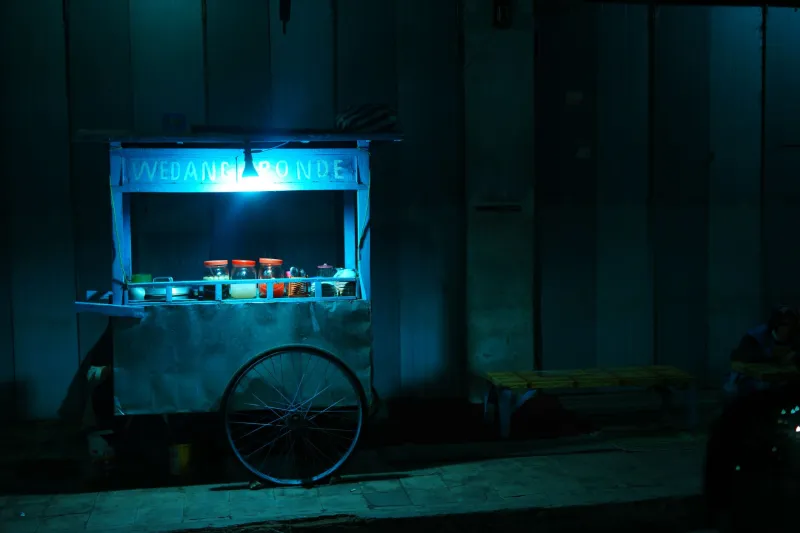
Pak Hendra has been frying tahu gimbal — a beloved Semarang specialty of deep-fried tofu, shrimp fritters, and boiled egg smothered in peanut sauce — from the same corner of Jalan Pemuda for eleven years. His cart is spotless. His regulars line up before he even fires up the oil. And his operating permit? It expired in 2019.
"I tried to renew it," he says with a shrug that carries more resignation than guilt. "The paperwork, the fees, the waiting — it never ends. So I just... kept cooking."
Pak Hendra is not an outlier. He is, by most estimates, the rule.
Across Semarang, Indonesia's fifth-largest city and the capital of Central Java, a sprawling informal economy sustains thousands of street food vendors who operate without valid licenses, official permits, or any meaningful government oversight. It is a system built on neighborhood alliances, quiet cash payments, and a mutual understanding between vendors and enforcement agents that has calcified over decades into something resembling its own parallel bureaucracy — one that feeds millions of people every single day.
How the System Actually Works
To understand Semarang's shadow permitting world, you have to first understand why official licensing is so difficult to obtain in the first place.
The formal process requires vendors to register with the city's Dinas Perdagangan (Department of Trade), secure a location permit from the local kelurahan (neighborhood administrative office), pass a basic food safety inspection, and pay a tiered fee based on cart size and location. On paper, it sounds manageable. In practice, vendors describe a process that can take anywhere from three months to over a year, costs that frequently exceed what a new vendor earns in their first few weeks of business, and inspectors who are rarely available and often require additional "facilitation fees" to move paperwork along.
"The system is designed for someone who already has money," says Ibu Ratna, a bakso seller who has operated near Pasar Johar for eight years without a valid license. "If I had that kind of money, I wouldn't need to sell meatballs on the street."
Into this gap steps the informal system. Neighborhood-level fixers — sometimes called koordinator lapangan, or field coordinators — act as middlemen between vendors and local enforcement. For a weekly or monthly fee, typically ranging from 20,000 to 100,000 Indonesian rupiah (roughly $1.25 to $6.25), these coordinators provide vendors with something the government cannot: reliable, predictable protection from raids and fines.
Think of it less like organized crime and more like a neighborhood HOA with an enforcement arm. The coordinators know when city inspectors are scheduled to sweep through an area. They communicate locations where vendors can set up with minimal risk. They negotiate on behalf of vendors caught without papers. And in exchange, they collect their fees with quiet regularity.
The Officials Who Look the Other Way
Asking city officials about the informal permitting system is a study in careful language.
One mid-level official at the Semarang Department of Trade, who agreed to speak on background, describes it as "a known situation that requires a nuanced approach." He is careful not to endorse the system but equally careful not to condemn it. "These vendors provide essential services to communities that cannot always afford restaurants," he says. "The city is aware that full enforcement would create significant social disruption."
That's a diplomatic way of saying that if Semarang actually cracked down on every unlicensed street vendor tomorrow, a meaningful portion of the city's working-class food infrastructure would disappear within a week.
Enforcement agents — known locally as Satpol PP, the civil service police unit responsible for upholding regional regulations — operate in a similarly complicated space. Officers in the field are frequently from the same neighborhoods as the vendors they're tasked with monitoring. Cracking down hard on a neighbor's livelihood carries its own social costs.
"We enforce the rules," one Satpol PP officer says carefully, when asked about unlicensed vendors near Simpang Lima, Semarang's central plaza. "But enforcement has to be proportional and consider community welfare." He pauses. "It's a balance."
What's Actually at Stake
For American readers, it might be tempting to frame this as a simple story about government corruption or regulatory failure. But the reality on the ground is considerably more layered.
Semarang's street food culture is not incidental to the city — it is foundational. Dishes like nasi goreng kambing, mie kopyok, and es campur are not available at sit-down restaurants with air conditioning and laminated menus. They exist almost exclusively in the informal economy, prepared by vendors who have spent years, sometimes decades, perfecting recipes passed down through families. The licensing system, as currently structured, is simply not built to accommodate this reality.
Community food advocates argue that the informal permitting system, for all its messiness, has actually preserved culinary diversity that formal regulation would have inadvertently destroyed. "If every vendor had to pass through the same bureaucratic process, only the ones with capital and connections would survive," says one local food culture researcher who studies informal economies in Indonesian cities. "You'd end up with a sanitized, homogenized version of Semarang's food scene. The best stuff would be gone."
That argument cuts both ways, of course. Consumer advocates point out that the absence of formal oversight means food safety standards are essentially self-policed. There are no mandatory inspections, no guaranteed hygiene protocols, no accountability mechanisms when something goes wrong. For most vendors, reputation is the only quality control — and in tight-knit neighborhoods, that's often enough. But it's a system with real vulnerabilities.
The Cat-and-Mouse That Never Ends
What makes Semarang's shadow permitting economy genuinely precarious is its dependence on informal relationships that can dissolve without warning.
A new kelurahan chief who wants to make a name for himself can disrupt the entire network in a neighborhood overnight. A political push from city hall ahead of elections can trigger enforcement sweeps that scatter vendors who have operated in the same spot for years. The coordinators who provide protection have no formal authority and no legal standing — their power exists entirely at the pleasure of the officials and officers who choose not to interfere.
Pak Hendra knows this. He's been swept twice in eleven years — once in 2021 when a new Satpol PP commander ordered a district-wide crackdown, and once in 2023 during what vendors described as a pre-election "clean city" initiative. Both times, he paid a fine, moved his cart two blocks over, and was back in operation within a week.
"It's just the cost of doing business here," he says, ladling peanut sauce over a fresh order with practiced ease. "The city needs us. We know it. They know it. Nobody wants to admit it."
He slides the plate across to a waiting customer — a university student who eats here three times a week and has never once thought to ask whether Pak Hendra has a license.
She probably doesn't need to. The food is extraordinary. And in Semarang, that has always been its own kind of credential.